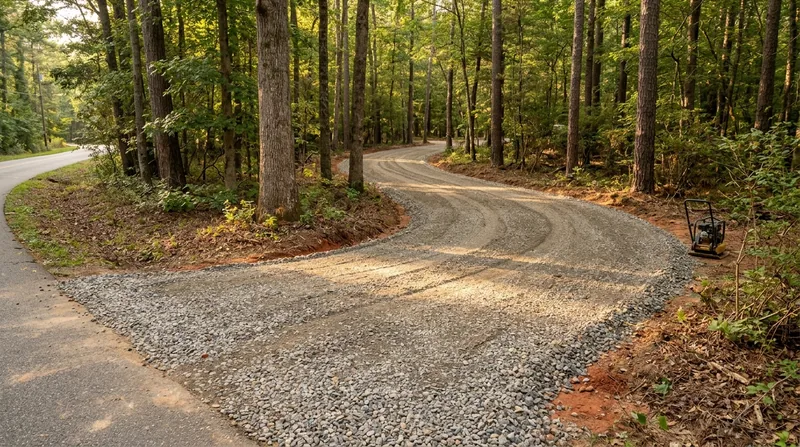




Gravel Driveway Installation & Grading in Raleigh is not a decorative choice on rural properties and properties toward Harnett and Chatham, it is a necessity driven by the Piedmont clay that lies under most of Raleigh and Wake County. That clay is dense, slow to drain, and softens dramatically when water pools in it during heavy rain. Without proper grading and a compacted stone base, a gravel drive becomes a muddy rut within a season. We shape the grade to shed water, install crushed stone at the right depth and density, and compact it so water runs off instead of pooling in the clay below. The result is a drive that stays firm through thunderstorms, ice storms, and the soaking rains that come with tropical remnants. If you are planning a new gravel drive or need to rebuild one that has failed, a free estimate will show you exactly what the work requires.
Why Proper Grading Matters in Raleigh's Clay Soil
The land under Raleigh slopes gently toward the Neuse River, and most residential driveways are built across that slope or follow it downhill. A driveway that is not graded correctly becomes a dam: water collects instead of running off, the clay underneath saturates, and the whole surface begins to rut and settle. In spring and after heavy rain, this is the most common problem we see on gravel drives. The fix is grading that sends water toward the shoulders and away from the garage, combined with a base layer of stone that is thick enough and dense enough to distribute weight and drain moisture. Proper grading prevents the clay from softening and protects your investment in the drive itself.
- We establish a crown or a cross-slope so water sheds to both sides instead of running downhill and pooling.
- We install crushed stone or recycled asphalt millings at a compacted depth of 4 to 6 inches, depending on the clay condition and expected traffic.
- We proof-roll the base with heavy equipment to compress it and verify it will support your vehicle without rutting.
- We shape the shoulders so water does not run back into the drive from the adjacent ground.
The result is a gravel drive that stays usable year-round and does not require rebuilding every two or three years.
Key info: Raleigh-area clay is particularly prone to softening because it sits on saprolite, a weathered rock layer that holds water. A driveway built on this ground without proper base preparation will fail within one to two seasons of heavy use. Grading and compaction are not optional steps; they are the foundation of any gravel drive that will last.
How We Install and Grade a Gravel Driveway in Raleigh
The work begins with a site visit and measurements. We assess the existing ground, the slope, the clay condition, and drainage patterns. We then plan the grade line, the stone depth, and the compaction sequence. On the day of installation, we shape the subgrade, install and spread the stone, compact it in lifts, and finish the shoulders. The entire process typically takes one to two days for a standard residential drive, depending on length and width. We provide a written estimate with tonnage specifications so you know exactly what you are paying for.
- We stake out the drive and establish the grade elevation so water runs off in the right direction.
- We remove soft or saturated clay and replace it with compacted stone if the subgrade is too weak to carry the base.
- We place crushed stone or recycled asphalt millings in compacted lifts, typically 2 to 3 inches per lift, and proof-roll each layer.
- We finish with a top layer of smaller stone or millings that binds slightly and provides a firm, stable surface.
- We shape the shoulders and verify drainage patterns so water does not collect at the edges or run back into the drive.
Once the work is complete, the drive is ready to use immediately. Gravel does not require curing time the way asphalt does.
Local example: A property in southern Raleigh near Knightdale with a 150-foot gravel drive that had rutted badly after two wet seasons required 18 tons of recycled asphalt millings, a re-graded subbase, and full compaction. The cost was $2,400, and the drive has remained firm for three years since. Without proper grading, that property would have needed the work done again within 18 months.
Gravel Driveway Installation Methods and Materials
| Approach | Description | Best for |
|---|---|---|
| Crushed stone base with gravel top | Angular crushed stone (typically #411 or similar) compacted as the base, topped with smaller crushed stone or pea gravel for finish. | Most residential drives; provides good drainage and stability; requires occasional raking and topping. |
| Recycled asphalt millings | Reclaimed asphalt from milling or demolition, compacted in lifts; binds slightly over time and creates a semi-firm surface. | Budget-conscious; good for clay soil because it compacts well; lasts longer than loose gravel before requiring maintenance. |
| Recycled asphalt plus stone blend | Recycled asphalt as the base layer, topped with crushed stone or gravel for appearance and traction. | Properties that want durability and a finished look; combines the compaction benefits of millings with the aesthetic of traditional gravel. |
| Full subgrade preparation and grading | Removal of failed or soft clay, replacement with compacted stone, and reshaping of the entire drive profile for optimal drainage. | Drives that have rutted or failed; properties with poor natural drainage; long-term durability is the priority. |
Each method is priced and specified on site. We recommend recycled asphalt millings for most Raleigh properties because the material compacts well in our clay soil, binds slightly as it ages, and offers good value. See our recycled asphalt and millings driveway page for more detail on that material.
Gravel Driveway Installation & Grading Cost in Raleigh: What to Expect
A basic gravel driveway installation with proper grading and compaction starts at $950 for a short residential drive (50 to 80 feet long, 10 to 12 feet wide) with good existing subgrade. Longer drives, drives that require subgrade removal and replacement, or properties with poor drainage will cost more. A 150-foot drive with full subgrade preparation and recycled asphalt base typically runs $2,200 to $3,200. The primary factors that move the price are the length and width of the drive, the condition of the existing clay, whether soft material must be removed and replaced, and the type of stone or millings you choose. We always provide a written estimate with tonnage specifications before we start work. Visit our pricing page for a full breakdown by service and material type.
Get two or three estimates from local contractors. A price that seems too good is usually a sign that the contractor is cutting corners on compaction or base depth. Ask each contractor for tonnage specs and the compaction method they will use. The difference between a drive that lasts five years and one that fails in two is in the base preparation, and that work is not always visible in the final price.
Gravel Driveway Installation & Grading Near Me: What Raleigh Homeowners Should Know When Hiring
Hiring a contractor for gravel driveway work is straightforward if you know what to look for. First, verify that the contractor is fully insured; ask to see a certificate of insurance and confirm that it covers property damage and liability. Second, get everything in writing: the scope of work, the materials to be used, the tonnage, the compaction method, and the total price. Third, check references from recent work in your area. A contractor who has done work in Raleigh or nearby towns like Cary, Durham, or Apex can show you completed drives and connect you with homeowners. Fourth, if your property is in an HOA community, verify that the HOA permits gravel driveways and what standards apply. Some master-planned communities in Wake County require asphalt or concrete only. Fifth, understand that North Carolina law (N.C. Gen. Stat. 87-100) requires a utility locate from North Carolina 811 before any excavation, including grading work; a responsible contractor will call for this locate at no cost to you.
- Verify that the contractor has a written estimate with tonnage and compaction specifications, not just a price.
- Ask how many years the contractor has been in business and request references from properties in Raleigh or Wake County.
- Confirm that the contractor is fully insured and will provide a certificate of insurance before work begins.
- Check whether your HOA or municipality has any restrictions on gravel driveways or requirements for permits; a local contractor will know these rules.
- Understand that a reputable contractor will call North Carolina 811 for a utility locate before any digging begins, at no extra charge to you.
If you want to move forward, call us at (919) 746-7359 for a free estimate. We have been serving Raleigh and surrounding areas since 2009, and we provide written estimates with tonnage and compaction details so you know exactly what you are paying for and what to expect.
Gravel Driveway Installation & Grading in Raleigh: Pricing Guide
| Service | Price | Details |
|---|---|---|
| Standard gravel driveway (50-80 feet) | Starting at $950 | Proper grading, compacted stone base, finished top layer, assumes good existing subgrade condition |
| Medium residential drive (100-150 feet) | Starting at $1,800 | Full grading, recycled asphalt or crushed stone base in multiple compacted lifts, shoulder shaping |
| Long or complex drive with subgrade prep | Starting at $2,400 | Removal and replacement of soft or saturated clay, full base preparation, extended compaction, drainage shaping |
| Recycled asphalt millings upgrade | Add $200-$500 | Substitute recycled asphalt for crushed stone base; material compacts well in Raleigh clay and binds over time |
| Estimate and site visit | Free | Response within 24 hours, no obligation, written estimate includes tonnage and compaction method |
Indicative pricing, the exact cost depends on square footage, finish, and site access. Free personalized estimate within 24h at (919) 746-7359.


