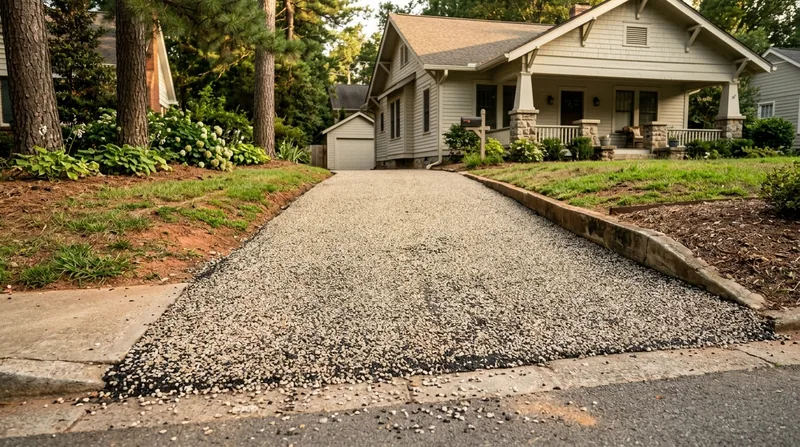




Tar and chip driveways in Raleigh offer a textured, durable surface for long rural drives and older neighborhood streets where a compacted base and proper drainage matter as much as the surface itself. The Raleigh area sits on Piedmont red clay over saprolite, dense and slow to drain, which means water finds every weak edge during the heavy summer thunderstorms and soaking rains that follow tropical systems. Tar and chip gives you a rustic appearance with real holding power, sprayed with a liquid binder, embedded with stone chips, and rolled firm so the surface stays put through Raleigh's wet seasons and temperature swings. Unlike fresh asphalt, tar and chip hardens gradually and requires no seal coat during the cure period. We spray the binder, embed the stone, and roll it down so the surface holds up season after season without the pooling and edge failure that plague driveways built on weak prep or poor pitch.
Why Tar and Chip Driveways Matter in Raleigh's Older Neighborhoods and Rural Drives
Tar and chip is the classic choice for long rural lanes, unpaved roads, and the older Raleigh neighborhoods where a driveway curves and drops to follow rolling ground that falls toward the Neuse. The Piedmont clay underneath shifts and settles, especially through wet spells, so a surface that flexes slightly and sheds water quickly outlasts rigid materials that crack under movement. The textured surface grips tires in wet conditions and breaks up the monotony of a quarter-mile farm drive better than gravel alone. Hot humid summers, occasional ice storms, and days of soaking rain all test a driveway's edges and low spots, and tar and chip handles that cycle because the material compacts and bonds gradually rather than hardening all at once.
- Tar and chip bonds stone chips to a compacted base using a spray-applied liquid binder that cures slowly and flexes with ground movement.
- The textured surface sheds water quickly and grips tires in wet conditions without the slickness of fresh asphalt.
- Long rural drives in Wake County, Johnston, and Harnett benefit from tar and chip because the material works well on uneven terrain and adapts to settling.
- Older Raleigh neighborhoods like Oakwood and around Five Points often use tar and chip to preserve neighborhood character while improving durability.
- The surface requires no seal coat during the first six to twelve months, which saves money during the critical cure period.
Tar and chip costs less than hot mix asphalt and lasts longer than recycled millings alone, making it the practical middle ground for rural property owners and HOAs managing long drives.
Local example: A half-mile private road in Fuquay-Varina serving five homes gets tar and chip because the clay base shifts seasonally and the owners wanted a rustic finish that still sheds water and holds up through spring rains. The textured surface grips better than gravel when wet and costs less than a full asphalt overlay.
For more information on how tar and chip compares to other driveway options, see our guide to recycled asphalt and millings driveways and gravel driveway installation and grading.
For official guidance on driveway permits and regulations in your municipality, contact your local Raleigh building department or your village's planning office, as rules vary across Wake County and the surrounding region.
How We Build Tar and Chip Driveways in Raleigh: The Process from Base to Finish
Tar and chip installation starts with proper base preparation, especially on Raleigh's clay soils where drainage and compaction determine how long the surface lasts. We grade the drive, establish pitch so water runs away from structures, and compact the base material so the binder and stone have a firm foundation. Once the base is ready, we spray the liquid binder evenly across the surface, embed the stone chips immediately, and roll the whole thing firm so the chips seat into the binder and lock together. The process takes one to two days for a typical residential drive, depending on length and width.
- We inspect the existing surface and base, identify low spots and drainage problems, and propose grading or base repair if needed.
- We establish proper pitch so water runs away from your garage and foundation instead of pooling at the edge or low point.
- We grade and compact the base layer using equipment and proof rolling to confirm firm bearing before the binder goes down.
- We spray the liquid binder in an even coat across the entire surface using calibrated equipment.
- We embed the stone chips immediately after the binder is applied, distributing them evenly so the surface is uniform.
- We roll the finished surface with a compactor to seat the chips firmly into the binder and lock them together.
The finished driveway is ready to use within 24 to 48 hours, depending on temperature and humidity. Do not seal the surface for the first six to twelve months while the binder cures fully.
Local example: A 200-foot farm drive in Clayton running over rolling clay terrain gets graded for proper pitch, base compacted and proof-rolled, then tar and chip sprayed and rolled in one day. The drive sheds water toward the roadside ditch, stays firm through wet spells, and handles seasonal settling without cracking.
If your driveway needs full-depth repair or base replacement, see our page on driveway replacement for more detail on when patching or overlay makes sense and when the base is too far gone.
Tar and Chip Driveway Methods and Options
| Approach | Description | Best for |
|---|---|---|
| Tar and Chip on Compacted Base | Liquid binder sprayed over a compacted stone or recycled asphalt base, stone chips embedded and rolled firm, no asphalt required. | Rural drives, long lanes, older neighborhoods, properties where rustic appearance and drainage matter as much as durability. |
| Tar and Chip Over Recycled Millings | Recycled asphalt millings compacted as base, tar and chip binder and stone applied over top, creates a stable surface without new hot mix. | Budget-conscious owners, existing gravel or millings drives being upgraded, properties where mixed materials are acceptable. |
| Tar and Chip Resurfacing | Existing tar and chip or recycled surface milled or swept clean, new binder and stone applied over the prepared base. | Maintaining established tar and chip drives, refreshing surfaces that have worn but base remains firm, extending surface life. |
| Tar and Chip with Gravel Shoulders | Tar and chip applied to the drive centerline and travel area, gravel maintained on shoulders and edges for drainage and appearance. | Long private roads, HOA lanes, properties where rustic character and low cost matter, mixed-surface rural aesthetics. |
Tar and Chip Driveways Cost in Raleigh: What to Expect
Tar and chip driveways in Raleigh start at around $5 per square foot for a straightforward installation on a prepared base, with the final cost depending on base condition, drive length, width, grading and drainage work required, and local material costs. A typical 500-square-foot residential drive runs $2,500 to $3,500 before any base repair or extensive grading. Rural drives longer than 1,000 square feet or drives requiring significant base work, regrading, or drainage correction will cost more per square foot because the prep work and material volume increase. Getting two or three written estimates with tonnage and binder specifications lets you compare apples to apples and understand what each contractor is including in the quote.
The biggest cost variables are base condition (clay that has settled or shifted costs more to prep than firm ground), drive slope and length (longer drives use more material), and whether you need new grading or just a surface refresh. A drive with a weak or soft base requires excavation, base replacement, and compaction, which pushes the total significantly higher than a surface-only refresh. Always ask whether the estimate includes base preparation, proof rolling, and grading, or if those are separate line items.
Cost reality: A 300-foot drive in Raleigh with good existing base and moderate grading needs runs roughly $1,500 to $2,000. The same drive with soft clay that needs excavation and base replacement runs $2,500 to $4,000. A half-mile rural lane with poor drainage and settling runs $4,000 to $7,000 or more because of the material volume and grading work involved.
For a detailed breakdown of pricing across all our services, including material and labor ranges, visit our full pricing page. Call (919) 746-7359 for a free written estimate with tonnage and binder specifications included, no obligation to book.
Hiring a Tar and Chip Driveway Contractor Near Me: What to Look for in Raleigh
When you hire a contractor for tar and chip work in Raleigh or the surrounding Wake County area, verify that they carry liability insurance and provide a written estimate with binder type, stone size, tonnage per square foot, and base preparation details spelled out. Ask for references from recent local jobs, call those references, and ask whether the surface held up and whether drainage worked as promised. Understand that North Carolina has no paving-specific license, though any single undertaking of $40,000 or more does require a state General Contractor license from the North Carolina Licensing Board for General Contractors. Most residential tar and chip work falls below that threshold, but you should always ask a contractor whether they carry the appropriate license for the scope of your job. Check whether your HOA or municipality has rules about driveway materials, especially in master-planned communities where architectural standards may restrict what surfaces are allowed.
- Get written estimates from at least two contractors, each with binder type, stone specifications, tonnage, and base prep details included.
- Call references from recent jobs in Raleigh or nearby areas and ask whether the surface held up, whether water drains properly, and whether the contractor stood behind the work.
- Verify that the contractor carries liability insurance and ask for a certificate of insurance before work begins.
- Ask whether your municipality requires a driveway permit and whether the contractor will help you navigate the permitting process.
- Check your HOA rules if applicable, as some master-planned communities restrict driveway materials or require architectural approval before work starts.
- Avoid contractors who appear unsolicited at your door, offer a price that seems too good, ask for a large cash deposit upfront, or provide no written contract.
The strongest sign of a trustworthy local contractor is a verifiable local address, local phone number, and a willingness to provide written estimates with full specifications and references you can actually call.
Ready to move forward? Contact us for a free estimate or call (919) 746-7359 to discuss your drive and get a written quote with no obligation.
Tar & Chip Driveways in Raleigh: Pricing Guide
| Service | Price | Details |
|---|---|---|
| Tar and Chip on Prepared Base | Starting at $5/sq ft | Includes binder, stone chips, rolling, and labor on a firm compacted base with proper pitch established |
| Tar and Chip with Base Grading and Prep | Starting at $6.50/sq ft | Includes grading, base compaction, proof rolling, binder, stone, and rolling on clay or uneven terrain requiring drainage correction |
| Tar and Chip Resurfacing Existing Drive | Starting at $4/sq ft | Refresh of established tar and chip or recycled surface, includes milling or cleaning, new binder, stone, and rolling on firm base |
| Long Rural Drives or Private Roads | On estimate | Pricing depends on length, terrain, base condition, drainage requirements, and whether gravel shoulders or full-width treatment applies |
| Travel and Site Visit | Included | No separate mileage or call-out fee for properties in Raleigh and surrounding Wake County service areas |
| Free Written Estimate | Free | Response within 24 hours at (919) 746-7359, includes tonnage and binder specs, no obligation to book |
Indicative pricing, the exact cost depends on square footage, finish, and site access. Free personalized estimate within 24h at (919) 746-7359.


