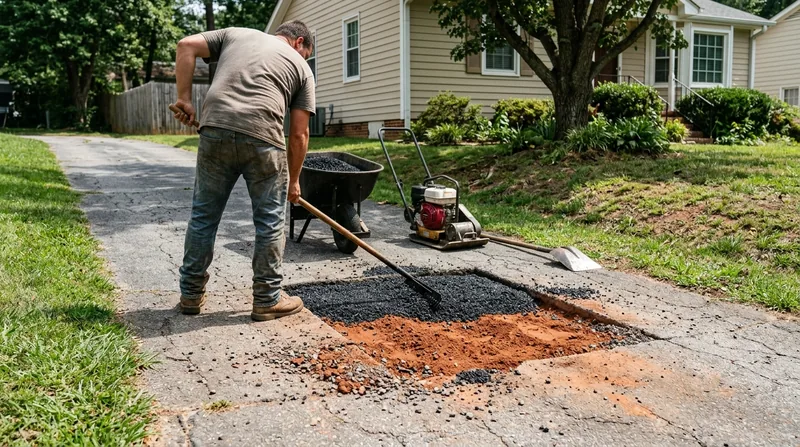




Raleigh's Piedmont terrain and red clay soil create ideal conditions for potholes to form, especially where saprolite has softened beneath asphalt. Heavy rain from summer thunderstorms and occasional ice events push water into weak spots, and the clay's poor drainage means that water stays trapped under the surface, expanding and contracting with temperature swings until the asphalt fails. Pothole repair and asphalt patching in Raleigh stops that failure in place, restores the surface, and prevents a small break from becoming a full-depth replacement. We cut out the failed area, rebuild the base with compacted aggregate, and fill with hot mix asphalt so the patch holds through the next wet spell and the seasons beyond.
Why Potholes Form in Raleigh and How Fast They Spread
Potholes don't start as craters. They begin as small cracks where water seeps into the asphalt and softens the base beneath. In Raleigh's climate, that water cycle repeats constantly: spring and fall rains soak the clay, summer heat bakes it, winter cold contracts it, and the next storm floods it again. Each cycle weakens the bond between the asphalt and its base, until a section of pavement finally gives way. Once a pothole opens, it spreads fast because traffic hammers the edges and water rushes into the void.
- We identify the full extent of damage by probing beneath the visible break to find where the base has lost bearing.
- We cut a clean perimeter around the failed area so the new patch bonds to solid asphalt on all sides.
- We remove all broken asphalt and loose base material down to firm, stable ground.
- We compact new aggregate base in lifts, with proof rolling to restore bearing capacity.
- We fill with hot mix asphalt, tamp, and strike level so water sheds away and the patch integrates with the existing surface.
Raleigh's rolling topography means that water naturally flows toward low spots, and those spots are where potholes cluster. Early patching stops the cascade.
Key info: Raleigh and surrounding areas (Cary, Durham, Wake Forest, Apex) sit on Piedmont clay that holds water like a sponge. A pothole that looks small at the surface often hides a much larger failure beneath. We always excavate to the full depth of damage before patching, because a shallow fill over soft base will fail again within weeks.
For more information on how we approach repairs across the region, see our driveway repair page.
How We Repair Potholes and Patch Asphalt in Raleigh
Every pothole is different, and the repair method depends on how deep the damage runs, how much area is affected, and whether the base is still solid or has failed. A small, isolated pothole might need only a full-depth patch. A larger area with alligator cracking or multiple failures usually signals that the base has lost capacity across a wider zone, and a larger repair or resurfacing becomes the better choice.
We start with a site visit to measure the failure, probe the depth, and assess the condition of the surrounding asphalt. We provide a written estimate that specifies the square footage, the depth of the patch, and the tonnage of material we'll use. That transparency lets you compare apples to apples when you get other estimates.
- We mark the repair zone and cut a clean perimeter with straight edges, typically 6 to 12 inches beyond the visible damage.
- We excavate the failed asphalt and base material, removing all loose or soft material down to stable ground.
- We compact new aggregate base in two or more lifts, with a roller or vibratory compactor to restore load-bearing capacity.
- We heat the perimeter of the existing asphalt so the new hot mix bonds chemically and mechanically to the old surface.
- We place hot mix asphalt, tamp it level with the surrounding surface, and allow it to cool before opening to traffic.
Real example: A driveway in Raleigh's Oakwood neighborhood developed a pothole near the garage apron after a wet winter. The pothole was roughly 18 inches across and 8 inches deep at the center. We excavated and found that the clay base had softened to a depth of 14 inches. We removed all soft material, compacted 4 inches of new stone base, and filled with 2 tons of hot mix. The patch has held for three years and counting.
To learn more about when patching is the right choice and when a larger repair makes sense, visit our asphalt resurfacing page.
| Approach | Description | Best for |
|---|---|---|
| Full-depth patch | Remove all failed asphalt and base, rebuild with new compacted aggregate and hot mix to original thickness. | Single or isolated potholes, clear failure boundaries, solid asphalt around the damage. |
| Partial-depth patch | Remove only the failed asphalt layer, leaving the base intact, and refill with new hot mix. | Shallow damage, intact base, small cracks or surface spalling without base failure. |
| Spray injection patch | Inject liquid asphalt binder into the pothole and tamp with aggregate to seal and stabilize. | Temporary repairs on roads with heavy traffic, holding a pothole until a permanent patch can be scheduled. |
| Resurfacing or overlay | Mill and overlay, or lay new asphalt over the existing surface, to address multiple potholes or widespread cracking. | Alligator cracking, multiple potholes across 30 percent or more of the surface, base still sound but surface worn. |
Pothole Repair and Asphalt Patching Cost in Raleigh: What to Expect
A single full-depth pothole patch in Raleigh typically starts at $450 and moves up from there, depending on the size of the failure, how deep the damage runs, and whether the base needs rebuilding. A pothole that is 12 inches across and 6 inches deep costs less than one that is 24 inches across and 10 inches deep, because the second job requires more excavation, more base material, and more hot mix asphalt. If the base has softened over a wider area, the repair zone expands and so does the cost.
Other factors that affect price include access (a pothole in a tight corner of a driveway takes longer to repair than one in an open area), the condition of the surrounding asphalt (if the edges are already cracked or crumbling, we may need to cut a larger perimeter to reach solid material), and the distance to our shop (we serve Raleigh and surrounding areas with no separate travel charge). We provide a written estimate after a site visit, with the square footage, depth, and tonnage spelled out so you know exactly what you are paying for.
If you have multiple potholes or extensive cracking across the driveway, patching each hole individually may throw money away. A resurfacing or full-depth replacement often makes better financial sense. We'll recommend the best option for your situation at no charge.
For detailed pricing across all of our services, visit our pricing page.
What to Look for When Hiring an Asphalt Paving Contractor Near Raleigh
The asphalt paving market has a history of fraud, particularly door-to-door sales pitches offering "leftover material from a nearby job" at a too-good-to-be-true price. The strongest protection is to work with a verifiably local contractor who has a physical address in the area, local plates on the trucks, and a track record you can check. We have been in business since 2009 and serve Raleigh, Cary, Durham, Wake Forest, Apex, Garner, Holly Springs, Morrisville, and surrounding towns.
When you call for an estimate, ask for a written proposal that includes the square footage of the repair, the depth of the patch, and the tonnage of material. A professional estimate should specify exactly what work will be done and what it will cost. Avoid any contractor who quotes a price over the phone without seeing the job, or who asks for a large cash deposit before work begins. Get at least two or three estimates so you can compare scope, materials, and price.
- Verify that the contractor is fully insured with general liability and workers compensation coverage.
- Ask for references from recent work in your neighborhood, and follow up with those homeowners.
- Check whether the work requires a permit in your municipality (Raleigh, Cary, Durham, and other cities have different rules, so verify with your local building department).
- Confirm that the contractor will call 811 before any excavation to locate utilities, as required by North Carolina law.
- If your driveway is in an HOA community, check the architectural standards to ensure the repair meets the rules.
We are fully insured and happy to provide references and a free estimate. Call us at (919) 746-7359 or contact us online to schedule a visit.
Pothole Repair & Asphalt Patching in Raleigh: Pricing Guide
| Service | Price | Details |
|---|---|---|
| Single pothole patch | Starting at $450 | Full-depth repair of isolated pothole up to 18 inches across, includes base and hot mix asphalt. |
| Large or deep pothole | Starting at $750 | Full-depth repair where base has failed over a wider area or damage extends 10 inches or deeper. |
| Multiple potholes or alligator cracking | On estimate | When 30 percent or more of surface is failed, resurfacing or replacement often costs less than patching individual holes. |
| Service area | No travel charge | Raleigh, Cary, Durham, Wake Forest, Apex, Garner, Holly Springs, Morrisville, and surrounding areas included. |
| Free estimate | No obligation | Written proposal with square footage, depth, and tonnage, response within 24 hours at (919) 746-7359. |
Indicative pricing, the exact cost depends on square footage, finish, and site access. Free personalized estimate within 24h at (919) 746-7359.


