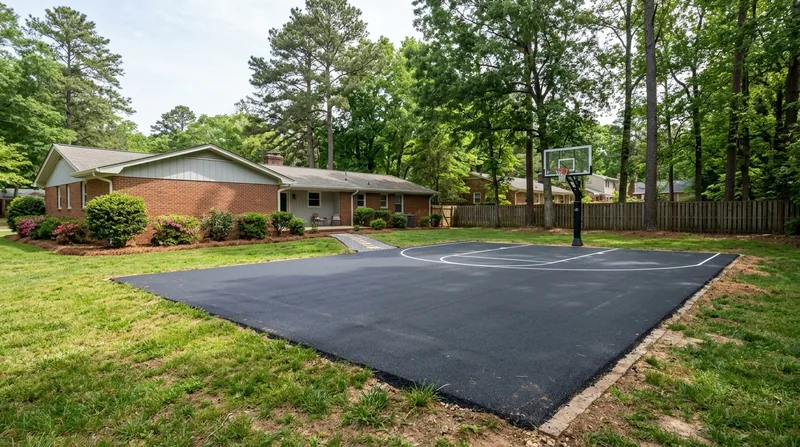




Raleigh's humid summers and clay-heavy Piedmont soil create unique challenges for backyard sports courts and recreational paths. The red clay under most of the city swells after heavy thunderstorms, and the freeze-thaw cycles of winter ice storms crack surfaces that aren't built on a proper base. Sports Court & Path Paving in Raleigh demands grading and compaction work that stops water from pooling under the court, then a hot mix asphalt finish that stays flat through the seasonal extremes. We grade and compact a stable base, then finish with hot mix so the court plays true through Raleigh's humid summers and ice-storm winters. Whether you're building a tennis court in Raleigh, a basketball court in Cary, or a walking path in Durham, the foundation is everything.
Why Backyard Courts Need the Right Base in Raleigh
A court surface is only as good as what sits under it. Raleigh's Piedmont clay doesn't drain well and shifts when wet, so a court built on compacted fill or native soil alone will crack and heave within a season or two. The base must be engineered to shed water away from the playing surface and support the load of players and equipment without moving. Hot mix asphalt, properly pitched and laid over a compacted stone base, is the material that holds up to Raleigh's weather and the pounding of a tennis game or basketball session.
- We remove vegetation and topsoil, then expose stable subgrade to build on.
- We bring in compacted stone base material and proof-roll it to ensure it won't settle.
- We pitch the surface slightly so water runs off the court instead of pooling at the edges or under the net.
- We lay hot mix asphalt in lifts, compacting each one to create a dense, durable playing surface.
- We finish with a smooth trowel and allow proper curing time before you use the court.
A court built this way will play flat and true for years, even after the heavy rain that comes with tropical storm remnants or the ice that coats Wake County roads each winter.
Key info: Raleigh's building code and the Wake County stormwater rules require that impervious surfaces like courts be graded to shed water properly. Verify your local municipality's stormwater requirements and setback rules before you start. We help you navigate those rules, but the building department always has the final say.
For detailed guidance on what your city requires, check the Raleigh building department website or call us at (919) 746-7359 to discuss your project.
How We Build a Court That Lasts: Step by Step
Every court starts with a site visit and measurement. We walk the ground, check drainage, identify where water pools, and talk to you about how the court will be used. From there, we follow a proven sequence that accounts for Raleigh's soil and climate. The work takes planning, but the result is a court that won't heave or crack after the first hard freeze.
- We mark out the court boundaries and check them against your local building department rules and any HOA architectural standards that apply.
- We clear vegetation and remove topsoil down to stable subgrade, sloping the ground to direct water away from the playing area.
- We bring in compacted stone base, typically 4 to 6 inches, and proof-roll it with heavy equipment to confirm it won't settle under load.
- We lay hot mix asphalt in two lifts, compacting each layer with a vibratory roller to create a dense, stable surface.
- We finish the top course with a smooth trowel and allow it to cure before the court goes into service.
The entire job typically takes three to five working days depending on court size and site conditions. Once the asphalt has cured for 24 to 48 hours, you can walk on it; full cure and maximum strength take six to twelve months, during which you should avoid heavy equipment or sealing the surface.
Example: A homeowner in Apex wanted a tennis court in her backyard. The lot sloped toward the house, and the clay was dense and slow-draining. We graded the site to slope away from the structures, brought in 5 inches of compacted stone base, and laid a 2-inch hot mix finish. The court now sheds water properly and has held flat through two winters of ice and rain. Related work: see our gravel driveway and grading service for more on base preparation.
Court and Path Paving Methods: What Works in Raleigh
| Approach | Description | Best for |
|---|---|---|
| Full-depth hot mix court | Compacted stone base plus 2 to 3 inches of hot mix asphalt, pitched and finished smooth. | Tennis courts, basketball courts, high-use recreational paths where durability and consistent play are essential. |
| Tar and chip surface | Liquid asphalt binding with stone chips, rolled into place on a prepared base. | Low-traffic paths, rural courts, or budget-conscious projects where a rustic look is acceptable. |
| Recycled asphalt millings | Compacted recycled asphalt and stone fines, creating a firm but permeable surface. | Parking areas, secondary paths, or temporary courts where cost is a priority and drainage matters. |
| Gravel and stone base only | Compacted stone and gravel, raked and maintained, without asphalt topping. | Rural paths, temporary courts, or sites where native materials are preferred and heavy use is not expected. |
For Raleigh's climate and soil, hot mix asphalt is the most reliable choice for a court that will play flat and last. The material sheds water, resists Piedmont clay heave, and holds up to freeze-thaw cycles. Tar and chip or recycled millings work for light-traffic paths where budget is tight, but they require more frequent maintenance and won't perform as well in heavy rain or ice.
Sports Court and Path Paving Cost in Raleigh: What to Expect
The cost of a backyard court or path depends on size, site conditions, and the surface material you choose. A full-depth hot mix tennis or basketball court in Raleigh typically starts at $8,500 for a small court on level ground with good drainage. Larger courts, sloped sites that need significant grading, or sites with poor drainage or difficult soil will cost more. The base work is where most of the cost lives, because proper grading and compaction are what make the court last. See our full pricing guide for detailed breakdowns.
Several factors move the price up or down. A court on sloped ground requires more grading and fill. A site with clay that holds water needs better drainage and a thicker base. Access matters too: if our equipment can't reach the site easily, we spend more time and fuel getting material in and compacted. A court in Holly Springs or Garner costs the same as one in Raleigh because we work throughout Wake County with no extra charge.
Always get two or three estimates before you book. A written estimate should include the base thickness, the asphalt thickness, the total square footage, the tonnage of material, and the timeline. If a contractor can't give you those details, keep looking. We provide written estimates with tonnage and thickness specs, and we stand by them.
New asphalt should not be sealed for the first six to twelve months while it cures and hardens. Sealing too early traps moisture and can damage the surface. Once curing is complete, regular maintenance like sweeping and minor crack repair will extend the life of your court.
Sports Court and Path Paving Near Me: What Raleigh Homeowners Should Know
Hiring the right contractor for a court or path is as important as choosing the right material. You're making a long-term investment, and the difference between a court that plays flat for ten years and one that cracks in two is the skill and care that goes into the base and the finish. Start by asking for references from courts the contractor has built in your area. Call those homeowners and ask if the court is still flat, if water drains properly, and if they would hire the contractor again. Check that any contractor you consider is fully insured and willing to provide a certificate of insurance. Get a written estimate that includes material thickness, tonnage, and timeline. Verify that the contractor understands your local building department rules and any HOA architectural standards that apply to your lot.
- Ask for at least three references from courts built in Raleigh or nearby in the past three years.
- Confirm that the contractor is fully insured and can provide proof of coverage before work starts.
- Get a written estimate that specifies base thickness, asphalt thickness, total tonnage, and project timeline.
- Verify that your local municipality does not require a permit for the court, or that the contractor understands the permit process if one is required.
- Check whether your HOA has architectural standards for outdoor courts or recreational surfaces.
We've been building driveways and courts in Raleigh since 2009. We work throughout Wake County and into surrounding areas, and we give free estimates within 24 hours at (919) 746-7359. Contact us at our contact page to request an estimate or to ask questions about your specific site.
Sports Court & Path Paving in Raleigh: Pricing Guide
| Service | Price | Details |
|---|---|---|
| Small tennis or basketball court, level site | Starting at $8,500 | Includes site prep, compacted stone base, and 2-inch hot mix asphalt finish on level ground with good drainage. |
| Medium court or large path with moderate grading | Starting at $12,000 | Includes sloping and grading, thicker base for clay-heavy soil, and hot mix finish on sites with drainage challenges. |
| Large court or complex site with poor drainage | On estimate | Sloped terrain, dense clay, difficult access, or extensive site work require an on-site measurement and assessment. |
| Tar and chip or recycled asphalt path | Starting at $4,500 | Lower-cost surface option for light-traffic paths, includes base prep and material but requires more frequent maintenance. |
| Travel and site visit | Included | No separate mileage fee or travel charge throughout Raleigh, Cary, Durham, and surrounding Wake County areas. |
| Free estimate | Free | Response within 24 hours at (919) 746-7359, includes site measurement, written specs, and no obligation to book. |
Indicative pricing, the exact cost depends on square footage, finish, and site access. Free personalized estimate within 24h at (919) 746-7359.


