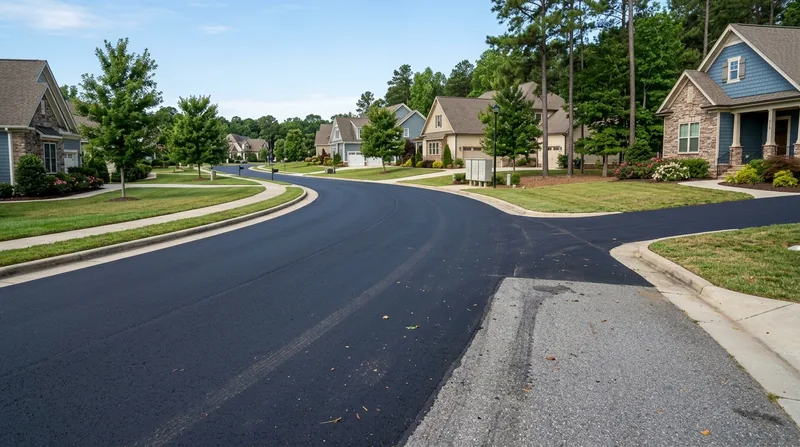




Private Road & HOA Paving in Raleigh serves the subdivision belt that sprawls across Wake County and into Johnston, Harnett, Chatham, Nash and Alamance counties, where master-planned communities and private developments depend on shared asphalt surfaces to move traffic safely year-round. The Piedmont red clay under most of Raleigh shifts and settles with seasonal moisture, and the hot humid summers bring thunderstorms that find every weak edge in a road surface, while the occasional ice storm and tropical remnants dump days of soaking rain that pools in low spots and accelerates failure. We build the base to carry the clay, then lay hot mix in binder and surface courses pitched for the rolling grade, so water sheds away from structures and low points instead of pooling there. Since 2009, we have worked with HOA boards and private road associations across the region to repair failed sections, resurface aging pavement, and build new roads that hold up to the climate and the soil. We measure every job on site, provide written estimates with tonnage and thickness specifications, and work within each community's architectural standards and local permitting rules.
Why Private Road & HOA Paving Matters in Raleigh: The Clay and the Weather
Private roads and HOA-maintained streets across the Raleigh area face a specific combination of soil and climate stress that turns small cracks into potholes and alligator cracking within two to four years if the base is not built correctly. The Piedmont red clay under neighborhoods from Oakwood through the post-war ranch belt to the fast-growing subdivisions in Apex, Cary, Wake Forest, and Holly Springs absorbs water, swells, and shifts under load, especially after heavy rain or during the wet spells that come with tropical systems. A driveway or road surface laid on an inadequate base will flex and crack as the clay moves, and once water gets into the base, the deterioration accelerates. HOA boards and private road associations are responsible for maintaining these surfaces, and deferred maintenance turns into emergency repairs that cost far more than planned resurfacing or timely patching.
- Piedmont red clay shifts seasonally with moisture, and a thin or poorly compacted base fails under that movement within two to four years.
- Summer thunderstorms and tropical system rains saturate the clay and find every weak edge in the pavement, accelerating pothole formation and base erosion.
- HOA boards and road associations need a long-term surface management plan, not emergency patching that spreads cost and downtime across multiple seasons.
- North Carolina 811 utility locates are required by law before any excavation for base prep, grading, or full-depth work, and must be called before the job starts.
- Most municipalities in Wake County require permits for driveway aprons, curb cuts, and impervious-surface additions, and HOA architectural standards often govern material and extent.
A properly engineered private road or HOA surface holds for eight to twelve years with routine maintenance, and careful base preparation is the difference between a road that lasts and one that fails in the first heavy rain.
Key info: HOA communities in Raleigh, Cary, Durham, and surrounding areas are subject to local permitting rules that vary by municipality. We help navigate those requirements and defer to each community's building department and architectural standards. For details on your specific jurisdiction, contact your HOA board or the local building department.
For more information on how local regulations apply to your property, visit the service areas we cover or call us at (919) 746-7359.
How We Build Private Roads and HOA Paving in Raleigh: Base, Binder, and Surface
Private road and HOA paving starts with the ground, not the asphalt. We remove the failed surface, grade and compact the subgrade, then build a base course of compacted stone or recycled asphalt that is proof-rolled to verify density and bearing capacity. Once the base is solid, we lay a binder course of hot mix asphalt, then finish with a surface course pitched to shed water away from structures and low points. The entire process is documented with tonnage and thickness specifications so the HOA board has a record of what was built and can plan future maintenance with confidence.
- Call North Carolina 811 for utility locates at least 48 hours before we arrive, and verify that all utilities are marked on site.
- We remove the failed asphalt surface and any unstable base material, exposing the subgrade and assessing drainage and soil conditions.
- We grade and compact the subgrade, then place and compact the stone or recycled asphalt base course to specification.
- We proof-roll the base with a heavy compactor to verify density and bearing capacity before any hot mix is laid.
- We lay the binder course of hot mix asphalt, compacted to specification, then finish with the surface course pitched for drainage.
- We measure and document tonnage, course thickness, and compaction results, and provide a written summary for the HOA board.
The entire job is planned around the HOA's schedule and any local permitting timelines, so traffic flow and community access are minimized.
Example: A private road in Apex serving twelve homes was laid on an undersized base in 1998 and showed alligator cracking by 2015. Rather than full replacement, we removed the top 2 inches of surface, laid a 1.5-inch binder course, and finished with a new 1.5-inch surface course. The road held for seven years before routine patching was needed, and the HOA saved 40 percent compared to full-depth replacement.
Learn more about resurfacing and overlay options that can extend the life of an existing road without full replacement.
Private Road & HOA Paving Methods and Materials
| Approach | Description | Best for |
|---|---|---|
| Full-Depth Replacement | Remove all failed asphalt and unstable base, regrade subgrade, compact new base course, and lay new binder and surface courses to specification. | Roads with severe base failure, extensive alligator cracking, or drainage problems that cannot be fixed with overlay. |
| Mill and Overlay | Mill off 1.5 to 2 inches of worn surface, inspect the remaining asphalt and base, then lay new binder and surface courses. | Roads with surface wear and minor cracking but a solid base; extends life eight to ten years at lower cost than full replacement. |
| Recycled Asphalt Base | Use reclaimed asphalt millings (RAP) as the base course material, compacted to specification, then lay new hot mix surface. | Budget-conscious HOAs and private roads; RAP performs well on stable subgrades and reduces landfill waste. |
| Partial Depth Patching | Remove failed asphalt in localized areas, inspect base, compact, and fill with new hot mix compacted to match surrounding surface. | Isolated potholes or failed sections; works only if the base under the patch is stable and fewer than 30 percent of the surface is failed. |
| Grading and Drainage Repair | Regrade the road to improve pitch and drainage, repair or install culverts, and compact subgrade before new base and surface. | Roads with standing water or poor drainage that accelerate base failure; often combined with full-depth or mill-and-overlay work. |
Private Road & HOA Paving Cost in Raleigh: What to Expect
The cost of private road and HOA paving depends on the scope of work, the size of the surface, the condition of the existing base, and local permitting and site access. Full-depth replacement of a private road serving a small subdivision starts at approximately $15,000 to $25,000 for a quarter-mile section, while mill-and-overlay work on the same section runs $8,000 to $12,000. Larger roads serving multiple subdivisions or longer stretches cost more, and jobs that require extensive grading, drainage repair, or culvert work add to the total. We measure the road on site, assess the base and subgrade, and provide a written estimate with tonnage and thickness specifications so the HOA board knows exactly what is being built and why.
The largest cost variable is whether the base is stable or requires replacement. A road with a solid base and surface wear benefits from mill-and-overlay, which is the most cost-effective long-term choice. A road with base failure or poor drainage requires full-depth replacement or extensive grading work, which costs more upfront but prevents emergency repairs and repeated patching over the next five to ten years. Getting two or three estimates from different contractors is always smart, and comparing the tonnage and thickness specifications in each estimate tells you whether the contractors are building to the same standard or cutting corners.
For a detailed pricing overview and current rates, call us at (919) 746-7359 for a free on-site estimate. We respond within 24 hours and provide tonnage and thickness specifications with every quote.
What to Look for When Hiring a Private Road & HOA Paving Contractor Near Me in Raleigh
Hiring the right contractor for a private road or HOA paving project is critical because a poorly built road will fail in the first heavy rain, and an emergency repair bill will follow. Start by verifying that any contractor you consider is fully insured and can provide proof of coverage. Ask for references from other HOAs or private road associations they have worked with in the past three years, and call those references to ask about the quality of the work, the contractor's responsiveness to questions, and whether the road has held up as expected. Get written estimates from at least two contractors, and compare the tonnage, course thickness, and base preparation details in each estimate to make sure they are building to the same standard.
Ask about permitting and utility locates. North Carolina law requires 811 utility locates before any excavation, and most municipalities require permits for road work, drainage changes, or driveway aprons. A contractor who does not mention permitting or utility locates is cutting corners. Check that the contractor is verifiably local with a local address and local plates, because the historic fraud in paving is the itinerant door-to-door crew offering "leftover asphalt from a job nearby" with no written contract, a large cash deposit, and an out-of-state truck. Honest guidance is the differentiator, and a contractor who proposes resurfacing before replacement, or patching before resurfacing, is working in your interest, not theirs.
If your HOA has architectural standards or design requirements, make sure the contractor is willing to work within those guidelines and can show examples of similar work. Call Raleigh Asphalt Paving at (919) 746-7359 for a free estimate and to discuss your specific needs. We have served HOAs and private road associations across Raleigh, Cary, Durham, Wake Forest, Apex, Garner, Holly Springs, Morrisville, and surrounding areas since 2009.
Private Road & HOA Paving in Raleigh: Pricing Guide
| Service | Price | Details |
|---|---|---|
| Mill and Overlay (quarter-mile private road) | Starting at $8,000 | Remove and recycle worn surface, lay new binder and surface courses; best for solid base with surface wear only |
| Full-Depth Replacement (quarter-mile private road) | Starting at $15,000 | Remove failed asphalt and base, regrade subgrade, build new base course, lay binder and surface; price increases with base instability |
| Grading and Drainage Repair (combined with paving) | On estimate | Regrade road for pitch and drainage, repair or install culverts, compact subgrade; added to full-depth or mill-and-overlay cost based on site conditions |
| Partial Depth Patching (per pothole or failed section) | On estimate | Remove and fill localized failures; cost depends on size and number of patches; works only if base is stable and under 30 percent failure |
| Travel and Utility Locates | Included | No separate mileage fee in Raleigh and surrounding service areas; 811 utility locate coordination is part of project planning |
| Free Estimate | No charge | On-site measurement, soil and base assessment, written estimate with tonnage and thickness specifications; response within 24 hours |
Indicative pricing, the exact cost depends on square footage, finish, and site access. Free personalized estimate within 24h at (919) 746-7359.


