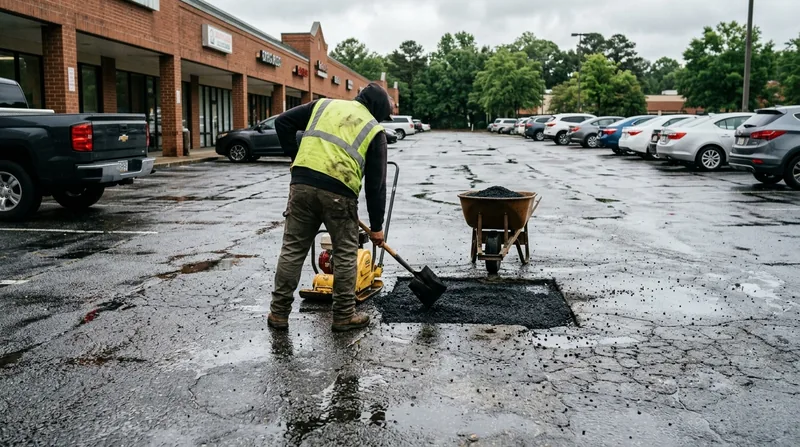




Parking lot repair and resurfacing in Raleigh stops the cycle of cracking, potholing, and water pooling that costs you money every spring. Raleigh's Piedmont clay and dense soils shift under parking lots when the base fails or water gets trapped underneath, and the humid summers and occasional heavy rain from tropical systems accelerate the damage. A lot that held for five years can crater in one wet season if the base wasn't built right or if drainage lets water sit at the asphalt-soil interface. We cut out the failed section, rebuild the base to proper compaction and pitch, and patch or resurface it so the lot drains and holds. The difference between a quick pothole repair and a full resurfacing comes down to how much of the lot has failed, what the base looks like underneath, and whether the structure can take an overlay or needs full-depth work. This guide walks you through the process, the cost range, and how to hire a contractor you can trust.
Why Parking Lot Repair and Resurfacing Matters in Raleigh
Raleigh parking lots fail in predictable ways. The red clay under most of the city doesn't drain fast, so water pools at the base of the asphalt, softens the subgrade, and causes the surface to crack and sink. Winter freeze-thaw cycles in the few cold weeks we get push cracks wider. Spring thunderstorms and the occasional tropical remnant dump inches of rain in days, and every weak spot becomes a pothole. A parking lot that hasn't been maintained for five or six years often shows alligator cracking (a spiderweb of interconnected cracks), which means the base has failed and the asphalt is no longer supported. At that point, patching individual potholes is throwing money away. You need to either resurface (lay new asphalt over the existing base if it's still sound) or replace it fully if the base is gone.
- Identify potholes, edge breaks, and alligator cracking as the early signs that repair or resurfacing is due.
- Check drainage around the lot perimeter and in low spots, because standing water is the fastest way to accelerate failure.
- Get a contractor to cut a test pit or probe the base thickness so you know whether an overlay will hold or if full-depth work is needed.
- Plan resurfacing or repair during the drier months (late spring through early fall) when the base is stable and the asphalt cures properly.
Waiting until the lot is a patchwork of repairs costs more in the long run and puts liability on you if someone trips or damages their vehicle.
Key info: North Carolina municipalities set stormwater and impervious-surface rules that may affect how your lot can be repaired or resurfaced. Verify requirements with your local building department before work begins. Raleigh, Cary, Durham, and other Wake County cities each have different standards.
How We Repair and Resurface Parking Lots in Raleigh
The process starts with a site walk and a written estimate that includes the thickness of the existing asphalt, the depth and condition of the base, and the scope of work. We measure the lot, probe or cut a test pit to see what's underneath, and determine whether you need pothole repair, a full resurface, or complete replacement. For repair work, we cut out the failed section, remove the damaged base material, compact new base to the proper density, and patch it with hot mix asphalt. For resurfacing, we mill off the top layer if needed for drainage or to level the surface, rebuild the base in low spots, and lay new asphalt to proper thickness and pitch. Every job includes a written estimate with tonnage and thickness specs so you know exactly what you're getting.
- We measure the lot and probe the base to determine whether repair, resurface, or full-depth replacement is the right choice.
- We cut out failed sections, remove soft or displaced base material, and compact new base to bearing capacity.
- We pitch the new surface to drain water away from buildings and low spots, preventing future pooling and base failure.
- We provide a written estimate with tonnage and thickness so you know the scope and can verify the work when complete.
The result is a lot that drains, holds traffic, and won't crater in the next wet season. If your lot needs more than repair, we can also discuss asphalt resurfacing and overlay or full parking lot paving and construction if the base is too far gone.
Real example: A retail lot in Raleigh near Five Points showed alligator cracking over 60 percent of the surface and standing water in the northeast corner after heavy rain. The base was intact but the surface was broken. We milled the top layer, filled low spots with new base, and resurfaced the entire lot. The cost was roughly one-third of full replacement, and the lot held for the next five years until the owner chose to upgrade.
Parking Lot Repair and Resurfacing Methods
| Approach | Description | Best for |
|---|---|---|
| Pothole and patch repair | Cut out the failed section, rebuild base, fill with hot mix asphalt, and compact flush with surrounding surface. | Isolated potholes and edge breaks when less than 20 percent of the lot is failed. |
| Milling and resurface (overlay) | Mill off the top layer to expose a sound base, fill low spots with new base, and lay new asphalt to proper thickness and pitch. | Lots with 20 to 40 percent cracking and a base that is still structurally sound. |
| Full-depth replacement | Remove all asphalt, excavate failed base, compact new base layers to specification, and lay new asphalt from subgrade up. | Lots with alligator cracking over 40 percent of surface or a base that has failed and shifted. |
| Base repair and partial resurface | Address specific low spots or failed sections, rebuild base locally, and resurface only the affected areas to blend with the existing lot. | Lots where failure is concentrated in one zone or where drainage has been recently corrected. |
Parking Lot Repair and Resurfacing Cost in Raleigh: What to Expect
Parking lot repair and resurfacing costs depend on the size of the lot, the extent of the damage, the condition of the base, and whether you need to address drainage. A pothole repair on a small lot might start at around $650 to $1,200, but a full resurface of a 10,000-square-foot lot typically runs $8,000 to $15,000 depending on base work and milling. Full-depth replacement is significantly higher because you are removing and replacing all layers, and costs can exceed $20,000 for a standard commercial lot. The biggest variable is what you find when you cut into the lot: if the base is sound, an overlay is affordable; if the base has shifted or failed, you need full-depth work and the cost climbs. We provide a written estimate on site with tonnage and thickness so you know the scope and can compare other bids. For detailed pricing guidance, see our full pricing overview.
The smartest move is to get two or three estimates from contractors who will probe the base, provide tonnage specs, and explain why they recommend repair versus resurface versus replacement. A cheap estimate that doesn't include base detail is a red flag. Invest the time in the estimate process and you'll avoid a repair that fails in one season.
Parking Lot Repair and Resurfacing Near Me: What to Look for When Hiring a Contractor
Hiring the right contractor for parking lot work is critical because a poor base repair or resurface will fail within a year or two, and you'll be back to square one. The strongest signal of a trustworthy local contractor is a local address, local phone number, and a track record in your area. Avoid any contractor who shows up unsolicited with an offer to use "leftover asphalt from a nearby job", quotes a price over the phone without seeing the lot, or asks for a large cash deposit upfront. Honest contractors provide written estimates, include tonnage and thickness specs, and are willing to answer questions about base prep and drainage.
- Verify that the contractor is fully insured and ask to see the certificate of insurance before work begins.
- Get a written estimate that includes lot size, asphalt thickness, base material and depth, and the total tonnage of material to be used.
- Ask for references from similar lots in Raleigh, Cary, or Durham, and call them to confirm the work held and the contractor was professional.
- Understand that municipal permits may be required for parking lot work in Raleigh and some surrounding cities, and verify with your local building department.
- If your lot is in an HOA or commercial development, check architectural or covenants documents to confirm that asphalt repair and resurfacing are permitted.
Once you've selected a contractor, contact us for a free estimate or call (919) 746-7359 to discuss your lot and get a detailed scope and price. We've been in business since 2009 and serve Raleigh and the surrounding Wake County area with written estimates and tonnage specs on every job.
Parking Lot Repair & Resurfacing in Raleigh: Pricing Guide
| Service | Price | Details |
|---|---|---|
| Pothole and isolated patch repair | Starting at $650 | Single pothole or edge break repair, includes base rebuild and asphalt patch, cost increases with depth and base damage |
| Parking lot milling and resurface (overlay) | Starting at $8,000 | 10,000-square-foot lot with sound base, includes milling, base fill, and new asphalt to proper thickness and pitch |
| Full-depth parking lot replacement | Starting at $20,000 | Complete removal and replacement including subgrade prep, base layers, and new asphalt, price depends on lot size and site conditions |
| Base repair and targeted resurface | On estimate | Focused repair of failed sections or drainage correction requires site inspection to determine scope and material needs |
| Free estimate | No obligation | Written estimate with tonnage and thickness specs, response within 24 hours at (919) 746-7359 |
Indicative pricing, the exact cost depends on square footage, finish, and site access. Free personalized estimate within 24h at (919) 746-7359.


